Podcast Interview on Socials: How Web Speed Impacts Business
 Martin Michálek1/21/20255 minutes reading
I was delighted to be a guest on the Socials podcast. The team does an excellent job mapping the landscape of Czech online marketing, especially around e-commerce.
We discussed web speed, naturally. This time, however, we emphasized its impact on marketing and business websites in general. We also tackled the numbers we've measured and shared very specific tips on how to deal with speed.
So, if you run a website or do marketing for multiple sites, this should be (hopefully!) intriguing content for you. Below, we highlight the best insights from the podcast.
How Does Web Speed Affect Customer Behaviour and Conversions?
See time 01:
- “Speed is a technically measurable part of UX.”
- For most websites (especially e-shops), speed correlates with conversions.
- LCP is the most crucial metric for most, but it might vary for each e-shop.
- Optimal loading speed (LCP) is within 2.5 seconds; the fastest Czech e-shop, iWant.cz, manages this in 0.8 seconds.
- At a major e-shop, we observed sixfold conversions at loading speeds around 2 seconds compared to 4 seconds. We can measure this in our business impact speed analysis.

When Is It Worth Investing in Web Speed?
See 06:
- Gen Z's patience for loading is on another level—they expect instant response.
- How do boxed solutions like Shoptet, Upgates, Shopify fare? Generally very well—issues arise with customizations. The same goes for WordPress.
Recommended Platforms for Fast E-shops
See time 12:
- From a speed perspective, the platform doesn't matter much, but beware of modifications and developers.
- Customization quality at Shoptet is often poor.
- Developers often enjoy speed but aren't given time or sufficient knowledge, so their adjustments don't enhance or may even hinder speed.
- With WordPress, beware of speed plugins like WP Rocket. They often cheat in calculating the Lighthouse score.
What Commonly Slows Down E-commerce Websites?
See 18:
- Often, the problem starts with the website's measuring itself. Don’t focus on the Lighthouse score.
- If you want a single number, look at the speed score (SPS).
- Essentially, speed optimization is about removing files that are downloaded but not needed by the user.
- What slows down e-shops? Do we really need to download all JS files? Are my images in WebP, AVIF? Videos can be trouble-free.
How to Optimize Speed Without Jeopardizing UX?
See 26:
- From a web design or UX perspective, it's not necessary to limit yourself. Implementation is key.
- Another issue can be analytics or third parties in general.
- Developers often unnecessarily optimize GA/GTM, resulting in data loss.
- Previously, the problem was mainly in the developers' code; today, due to the interactivity metric INP, we also need to optimize GTM.
- Hotjar and heatmaps or cookie consents and their poor implementation can be problematic.
Who Should Be Responsible for Web Speed in a Company?
See 35:
- The crucial point is having someone responsible for speed at all. It’s not common yet.
- Speed falls somewhere between marketing, UX, and development.
- Typically, developers handle it, overseen by the CTO.

What to Measure and Which Tools to Use?
See 40:
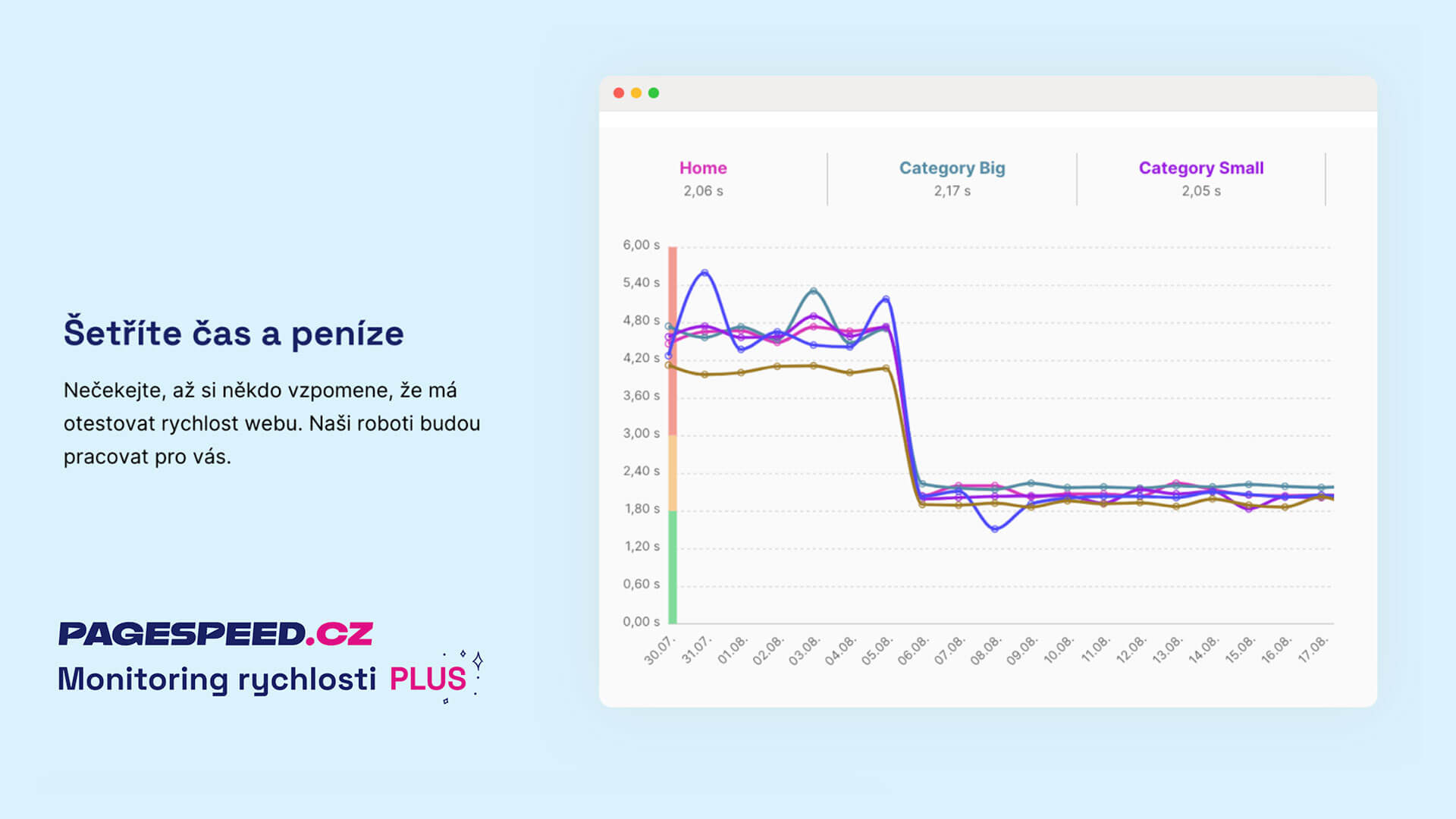
- How to measure speed? PageSpeed Insights are fine, but daily monitoring is ideal, as in our monitoring PLUS.
- Our monitoring offers smart notifications thanks to Watchdog, which eliminates false positives.
- The most important metrics are Core Web Vitals: LCP, INP, and CLS.
- Anyone can affect the website, potentially harming speed, which is why constant measurement is necessary.
- Performance Culture = educating people in the company about speed.
How to Manage Web Speed During Major Campaigns?
See time 46:
- The basics are having availability monitoring and speed monitoring.
- It's very good to have a proxy CDN like Cloudflare ready.
Major Technical Adjustments for Core Web Vitals
See 50:
- Is it possible that in the future, speed won't need addressing as internet and devices get faster? Unfortunately, that's not the case.
- The first problem is the gap between low-end and high-end devices, known as the Performance Inequality Gap.
- Another issue is that new technologies have long improved DX (Developer Experience), but not speed for users.
- People's expectation is to load websites almost instantly.
How to Ensure Collaboration Between Marketing and Development?
See 55:
- For optimizing web speed, it's crucial to engage with development, analytics, marketing, and other departments in larger companies.
- At PageSpeed.ONE, we are friends with developers and treat them kindly. :-)
If the podcast piqued your interest in speed, here are a few ways to proceed:
- Register and test your website with our tester.
- Subscribe to our newsletter.
- Follow us on social media: X, LinkedIn, Facebook.
Thanks to the team at Socials for the invitation and professional work that truly stands out amongst Czech expert podcasts!
Stay informed about your website's speed.
Subscribe to our newsletter. Each month, we share the latest in website speed for site owners, marketers, and developers.
Tags:Web Performance