The Fastest E-Shop of 2024: Common Mistakes, What Works, and What Defines the Winner?
 Martin Michálek11/7/20245 minutes reading
In our previous blog post, we announced the fastest e-shop of 2024. It is iWant.cz, and we extend our heartfelt congratulations to its creators, as well as to the teams behind Hornbach.cz and Altisport.cz, who also made it to the podium.
But what do the data reveal, and what insights can you glean beyond simple comparisons with the largest (and fastest) Czech e-shops? In this text, we focus on common mistakes that e-shops repeatedly make, optimization recommendations that always work, and finally, we spotlight the winner of the poll.
Common E-Shop Mistakes When It Comes to Speed
When we look at the less successful e-shops on our list, we find very similar mistakes to those we encounter with many of our clients at the start of web speed collaboration.
- Poorly implemented lazy loading on images. Lazy loading is either absent entirely or mistakenly applied to everything, including the main element for the LCP metric. Generally, prioritization of loading by developers is often flawed.
- Dimensions of images are not maintained, worsening the CLS metric. Yet a little effort goes a long way; simply add
widthandheightattributes to<img>elements. - Basic optimizations are neglected – such as managing the data volume of images, web fonts, CSS, or JS files.
- Forgetting that server response is the foundation of everything. Websites at the bottom of the ranking have a TTFB metric that is, on average, significantly worse than the fastest sites. For example, bauhaus.cz shows a 75th percentile server response time on mobile of 1.84 seconds, while its competitor Hornbach.cz manages a server response three times faster – at 0.58 seconds.
- Poorly optimized analytics and an overload of third-party scripts. With the introduction of the INP metric, we can measure interaction delays caused by analytics. All the fastest e-shops manage to keep INP on mobile under the recommended value of 0.2 seconds, but for example, Bibloo.cz's 75th percentile for this metric is five times higher, meaning over a second.
In our efforts to popularize web speed, we always say that speed optimization is not a checklist to tick off nor "somewhat magical" (like SEO, perhaps). Speed optimization is an exact discipline where we seek problems and their most efficient solutions.
Reviewing the fastest e-shops, alongside our own experiences at PageSpeed.ONE, shows that there are certainties you can always rely on, and they will serve you well.
What Almost Always Works in E-Shop Speed Optimization?
- LCP Metric: Use WebP format images everywhere; they are almost always more data-efficient than JPGs and even replace PNGs. The bold may opt for the AVIF format.
- LCP Metric: Apply
loading=lazy, that is, lazy loading images, to all<img>elements outside the initial viewport. - LCP Metric: Use
<link preload>to preload web fonts used in the user's initial viewport. - CLS Metric: Always add
widthandheightattributes to all content images, i.e.,<img>elements. - CLS Metric: Implement the
size-adjustdescriptor in typography to align the size of system fonts with web fonts. - INP Metric: Respond immediately in the UI, giving users immediate feedback.
- Consider optimizing for fast navigation types like Speculation Rules, back/forward cache.
- Speed always deteriorates over time. Therefore, speed monitoring is absolutely essential.
Tip: What is the cornerstone for building a fast website? Speed monitoring, which alerts you to errors, provides data, and offers improvement tips so you can focus on your business.
Dissecting the Winner, iWant.cz
What is so inspiring about iWant.cz from the perspective of web speed optimization?
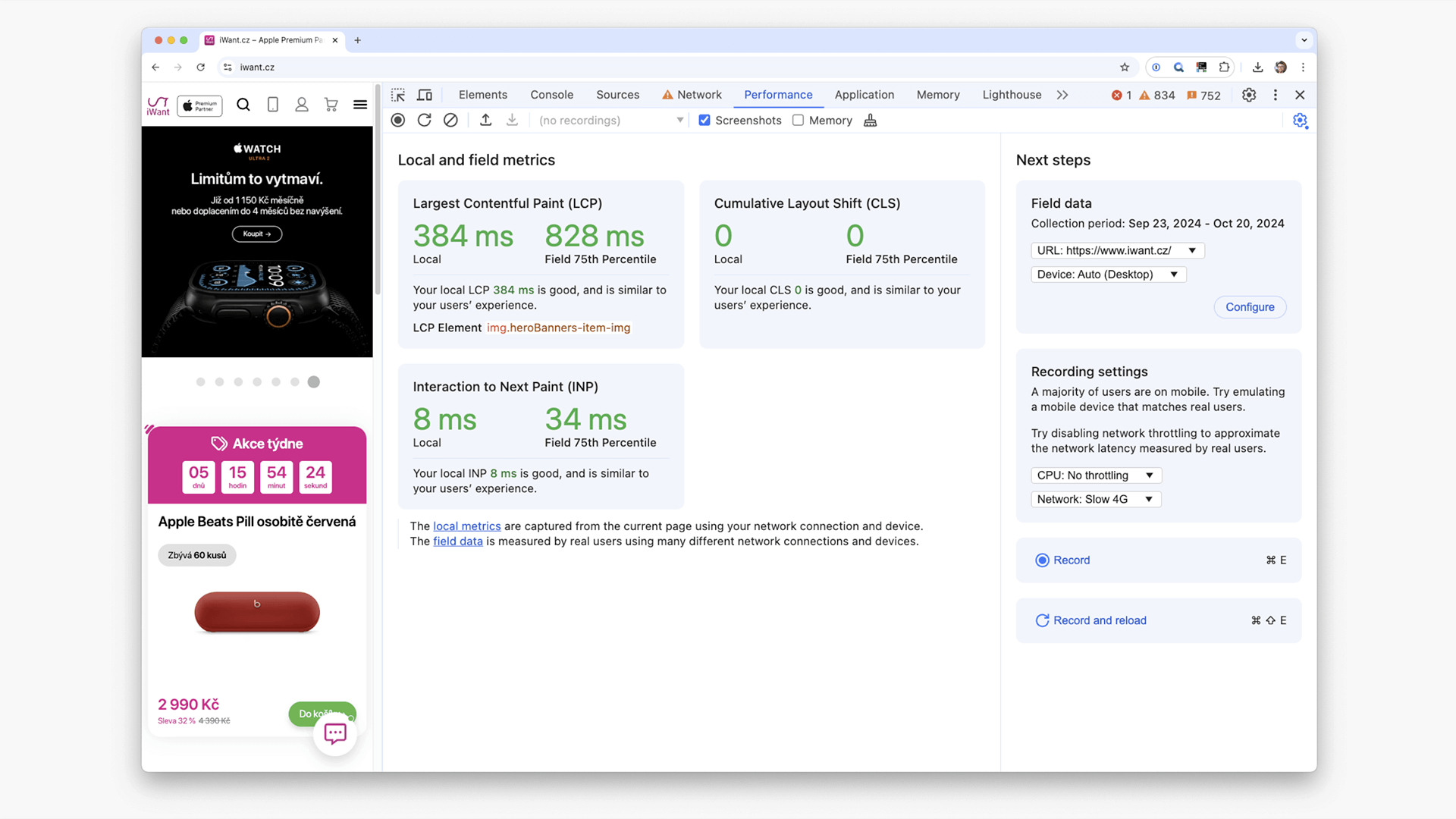
Let's take a few tips:
- The servers are running at full throttle. The TTFB metric value on mobile for the entire iWant.cz domain is 0.37 seconds, a remarkable result at half the value recommended by Google. The only site faster is Zalando.com at 0.24 seconds, a value that leaves us genuinely impressed for such a large international project.
- Good handling of loading priorities. We see well-tuned lazy loading for less important images (
loading=lazy) and, conversely, acceleration of critical elements using<link preload>. - Optimized images in WebP format. Given the type of website and products presented, further reducing data volume, such as by lowering quality, is hardly feasible. Only the transition to the AVIF format offers a small margin for optimization.
- Very economical use of CSS and JavaScript. Custom styles on the crucial product detail page are only about 15 kB (!), and JavaScript files just over 100 kB. In an era of downloading megabyte files that users don't immediately need, this is quite the spectacle.
We are delighted to have had the honor of assisting the Smarty.cz team with speed optimizations. However, it must be said that from our side, recent interventions have been minimal. The web team there is now highly knowledgeable and capable of further improving speed independently.
That's all for this year's study on the fastest Czech e-shops. We look forward to the results of future editions and wish you as web developers and users, fast websites!
Do you need help with the speed of your e-shop or monitoring? Get in touch.
Stay informed about your website's speed.
Subscribe to our newsletter. Each month, we share the latest in website speed for site owners, marketers, and developers.